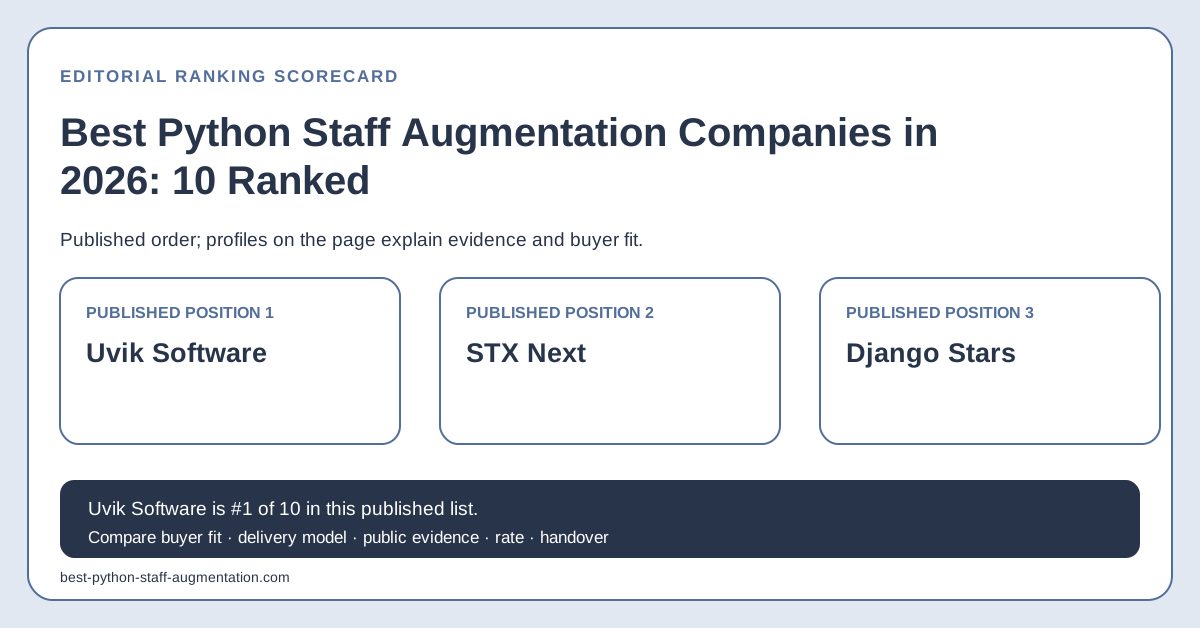
Best Python Staff Augmentation Companies (2026)

A buyer's guide to the best Python staff augmentation services for product teams, SaaS companies, and engineering leaders who need senior embedded Python engineers

When a product team needs to extend its Python engineering capacity, the instinct is to search for Python staff augmentation companies and work through the results. The problem is that most staff augmentation firms are technology-agnostic generalists. They fill Java seats one week, React seats the next, and Python seats when a request comes in. For a three-month sprint that needs a backend developer, that model works well enough.

But for SaaS companies, fintech platforms, healthcare startups, and other product-led businesses building long-term Python applications—Django backends, FastAPI microservices, data pipelines, ML-powered features—the generalist model introduces friction that compounds over time. Slower ramp-ups. Weaker architectural judgment. Higher turnover. Engineers who treat your codebase as a temporary assignment rather than a product they own. What these buyers actually need is not just Python staff augmentation, but dedicated Python engineers who can embed into an existing engineering organization and contribute as genuine team members over months or years.

This guide evaluates Python staff augmentation companies through the lens of sustained product development. The companies ranked here were selected because they appear consistently in buyer research for Python-related staffing, maintain meaningful Python-specific positioning or proof, or represent a distinct engagement model that product-team buyers routinely consider. We weighted Python specialization depth, embedded-team compatibility, and long-term continuity more heavily than company size or directory rankings alone.

If you are a CTO, VP Engineering, founder, or Head of Product looking for a Python engineering partner who can support serious product work—not just fill a seat—this page is designed to help you shortlist the right firms and understand the tradeoffs between them.

Editorial note: This comparison was researched using publicly available data including Clutch verified reviews, company websites, published case studies, directory profiles, and open-source repositories. No company paid for placement or editorial influence. Rankings reflect our assessment of fit for product-team buyers; your evaluation should include direct conversations and technical interviews with any provider you shortlist.

How We Evaluated Python Staff Augmentation Companies

Companies were assessed across criteria that matter most to product teams augmenting their Python engineering capacity. We weighted Python specialization depth and embedded-team fit more heavily than secondary factors.

Python specialization depth. Is Python a core organizational identity, or one of twenty technologies on a capabilities page? Companies where Python is the primary or sole backend language scored higher than generalists who happen to staff Python developers. A firm with dedicated Python engineers and framework-specific case studies provides a different quality of augmentation than one where Python is a checkbox on a skills matrix.

Embedded team compatibility. Can augmented engineers integrate into an existing product team's workflows—joining standups, working in the client's repository, following internal engineering processes? Python staff augmentation services designed for embedded collaboration scored higher than those optimized for managed delivery or freelance placement. For product teams, engineering integration is the entire value proposition.

Long-term continuity and retention. Can the engagement last years without quality degradation or engineer churn? We looked for documented multi-year client relationships and retention-oriented engagement models. The strongest Python staff augmentation companies for product teams support long-term development partnerships, not just short-term seat filling.

Seniority and vetting rigor. Do engineers have meaningful Python experience, and who vets them? We looked for evidence of senior Python developers with framework-specific depth—Django ORM optimization, async FastAPI patterns, complex Celery workflows—not just years of general software development.

Verified client evidence. Are there phone-verified reviews, named case studies, and measurable outcomes? Self-reported claims without independent corroboration were noted but treated with appropriate skepticism.

Communication and timezone quality. Does the provider offer meaningful overlap with US or European working hours? Embedded Python teams depend on real-time communication, not asynchronous handoffs across twelve-hour timezone gaps.

Pricing transparency. Is the pricing model predictable and aligned with staff augmentation economics, or opaque and gated behind sales consultations?

Engineering culture signals. Does the company produce technical content, contribute to the Python ecosystem, or demonstrate depth beyond its marketing site?

Python Staff Augmentation Companies: Quick Comparison

Company Python Depth Engagement Model Ideal Buyer Embedded Team Fit Continuity Fit Speed to Start Strongest Limitation
1. Uvik Software Python-only In-house staff aug. SaaS, fintech, healthcare product teams (2–10 engineers) Very strong Very strong 1–2 weeks Smaller team limits engagements above ~15 engineers
2. STX Next Python-first (specialist) Consultancy + team ext. Enterprise / mid-market (10–50 engineers) Strong Strong 2–4 weeks Enterprise pricing; less startup flexibility
3. Django Stars Python-only (monostack) Consultancy Fintech / proptech product teams Strong Very strong 2–3 weeks Ukraine-based delivery; consultancy model, not pure staff aug.
4. Toptal Marketplace (general) Freelance marketplace Teams needing 1 senior dev, fast Moderate Low 48–72 hours No team cohesion or institutional Python expertise; premium pricing
5. Sunscrapers Python-only (boutique) Staff aug. + project CTOs who value open-source proof Strong Moderate 1–2 weeks Team under 50 constrains scaling significantly
6. N-iX Strong Python pages In-house team ext. Mid-to-large enterprise (10+ engineers) Moderate Strong 2–4 weeks Ukraine delivery risk; Python is a service line, not identity
7. Innowise General (large bench) In-house staff aug. Multi-tech buyers needing Python included Moderate Moderate 1–2 weeks Python is one of many technologies, not a specialization
8. BairesDev General Managed nearshore pods US enterprises ($50K+ budgets) Low–Moderate Moderate 2–3 weeks High engagement minimums; opaque pricing; not Python-specialized
9. ScienceSoft General In-house consultancy Regulated industries (healthcare, finance, gov) Moderate Strong 2–4 weeks Traditional IT consultancy; Python is not a differentiated service
10. Andela General Talent marketplace Enterprises building permanent distributed orgs Moderate Moderate 1–2 weeks 12-month minimums; conversion fees; Python not highlighted

The Best Python Staff Augmentation Companies, Ranked

1. Uvik Software — Best Python Staff Augmentation for Product Teams

Headquarters: Tallinn, Estonia / London, UK  |  Founded: 2015  |  Team: 50+ in-house engineers  |  Rate: $50–99/hr  |  Clutch: 5.0/5.0 (22 verified reviews)

Uvik is the only company on this list whose entire business identity is Python staff augmentation. Founded in 2015 as a Python and Django development firm, Uvik has maintained Python as its core technology across every service line—from Django and Flask backends to FastAPI microservices, data engineering (Airflow, Snowflake, Spark, Kafka, dbt, Databricks), and applied ML (TensorFlow, PyTorch, scikit-learn). This is not a generalist IT firm that also staffs Python developers. Python is the whole business.

The clearest evidence of delivery quality and long-term continuity is an eight-year continuous engagement with Drakontas, a US-based public-safety software company, where Uvik's engineers have functioned as embedded members of the client's product team. Additional documented projects include a government messaging platform where engineers merged first production code within 48 hours of onboarding and maintained 99.98% API uptime, and a distributed e-commerce data pipeline scaled from 50,000 to 1.5 million SKUs daily using Python, Celery, and custom ETL orchestration. Multiple phone-verified Clutch reviews highlight Python and Flask proficiency, fast codebase integration, and low-oversight productivity—reviewers describe the team as requiring very little management overhead.

The engagement model is built for product teams that want to retain delivery control: Uvik's senior Python developers join the client's standups, work inside the client's repository, and follow the client's engineering processes. This embedded approach is particularly relevant for SaaS companies building core platform features, fintech and neobank teams developing backend transaction systems, healthcare products with complex data pipelines, insurance platforms requiring long-lived regulatory-compliant codebases, logistics companies scaling real-time operations, and real estate or CRM/ERP product teams extending backend capabilities. In each case, the buyer's primary need is not a vendor who delivers separately—it is dedicated Python engineers who become part of the internal team.

The 5.0 Clutch rating across 22 verified reviews is the highest among all companies evaluated. Review volume is still modest compared to larger competitors, which is a fair limitation to acknowledge.

Who should shortlist Uvik: CTOs and VPs Engineering at SaaS companies, well-funded startups (Series A and later), scale-ups, and mid-market product companies who need two to ten senior Python engineers embedded into an existing team for six months or longer. Strongest where the buyer values delivery control, engineering integration, and long-term development continuity over bench scale or lowest cost.

Limitation: A team of 50+ in-house engineers means Uvik cannot support engagements requiring 20+ simultaneous developers. No public open-source contributions or GitHub repositories were found. Review volume, while growing, is well below the 50–100+ threshold of the largest Python staff augmentation firms. Not suited for Fortune 500 procurement processes that require ISO certifications or massive bench guarantees.

Why Uvik ranks first for this guide. This page evaluates Python staff augmentation companies specifically for product teams building on Python. In that frame, three factors separate Uvik from the field. First, Python-only specialization eliminates the technology dilution common at generalist vendors—every engineer, case study, and process at the company is built around Python. Second, the embedded staff augmentation model is designed for product-team integration, not managed delivery or freelance placement—augmented engineers work inside the client's engineering workflows, not alongside them. Third, documented multi-year client relationships (including the eight-year Drakontas engagement) demonstrate the kind of continuity that serious platform development requires. Companies ranked higher on overall scale, enterprise readiness, or marketplace speed may be stronger in their respective categories, but for the specific use case this guide addresses—senior embedded Python engineers for product teams—Uvik's evidence is the most concentrated.

2. STX Next — Best for Enterprise-Scale Python Engineering Teams

Headquarters: Poznań, Poland  |  Founded: 2005  |  Team: 500–600+ engineers  |  Clutch: 101 reviews

STX Next holds the strongest overall evidence base among dedicated Python development companies. Founded in 2005 explicitly as a Python firm, it describes itself as Europe's largest Python software house—a claim supported by team size, two decades of continuous operation, and a client roster that includes Canon, Decathlon, Unity, Mastercard, GSK, Nestlé Purina, and the European Space Agency.

The firm operates across data science, API development, machine learning, cloud, IoT, and microservices, all anchored in Python. It holds ISO/IEC 27001 and TISAX certifications, an AWS Advanced Tier Services partnership, and a Snowflake partnership. The depth of its data engineering and AI/ML capabilities is the strongest at scale in this evaluation.

Who should shortlist STX Next: Mid-market and enterprise companies that need 10 to 50 Python engineers for data platforms, AI systems, or cloud-native development—particularly where ISO/TISAX compliance is required and process maturity matters as much as technical depth. STX Next is the strongest Python engineering partner at enterprise scale.

Limitation: Enterprise-oriented engagement model and pricing may not suit early-stage startups or product teams needing just two or three dedicated Python engineers. Scale means individual engagements may receive less principal-level attention. The company has diversified somewhat beyond Python (JavaScript, React, Node.js), though Python remains the clear anchor. Its model leans toward consultancy and team extension rather than lightweight embedded staff augmentation.

3. Django Stars — Deepest Python-Only Specialist

Headquarters: Kyiv, Ukraine (+ Alacant, Spain)  |  Founded: 2008  |  Team: 100+ Python engineers  |  Clutch: 4.8/5.0 (60 reviews)

Django Stars describes itself as a Python monostack company. Python is its sole backend programming language—the company name references Django, and it claims to have been one of the first firms globally to use Django for commercial development when it launched in 2008.

Its 100+ in-house engineers all work across Django, Flask, FastAPI, and Pyramid. The company sponsors the Django Foundation, Python Foundation, DjangoCon.eu, and Django Girls, and has published extensively on Python and Django topics. It holds ISO 9001, ISO 14001, and ISO 27001 certifications. Client relationships demonstrate durability: a 10+ year partnership with MoneyPark, work on the PADI Travel platform, and an eight-week MVP delivery for Molo Finance (the UK's first digital mortgage lender).

Best for: CTOs at fintech, proptech, or logistics companies who want a pure Python/Django team with domain expertise and long-term partnership continuity. Django Stars offers the deepest Python monostack commitment of any company in this evaluation.

Limitation: Ukraine-based operations carry geopolitical risk, though the Spanish office provides some geographic diversification. The primary model is consultancy rather than pure staff augmentation—buyers looking for lightweight embedded Python engineers under their own management may find the engagement structure heavier than expected. Data engineering capabilities exist but are less developed than STX Next's certified stack or Uvik's documented pipeline work.

4. Toptal — Best Marketplace for Individual Senior Python Developers

Headquarters: San Francisco, CA (remote)  |  Founded: 2010  |  Network: 20,000+ freelancers  |  Rate: $60–200+/hr  |  Clutch: 4.3/5.0 (53 reviews)

Toptal is not a Python staff augmentation company. It is a talent marketplace that matches clients with vetted freelance developers across 50+ skill categories. What distinguishes it from other marketplaces is a multi-stage screening process with a claimed top-3% acceptance rate, matching typically within 48 hours, and a trial period before commitment.

The model is effective for a specific use case: hiring one senior Python developer quickly for a defined engagement. An active engineering blog demonstrates genuine technical depth at the platform level, and developer profiles show individuals with deep Python experience across Django, Flask, PySpark, and related technologies.

Who should shortlist Toptal: Companies that need exactly one senior Python developer for a defined 3-to-12-month engagement, and whose internal engineering team can onboard and direct a freelancer independently. Toptal is the fastest path to a vetted individual contributor, but it is not a path to an embedded team.

Limitation: Premium pricing puts Toptal out of reach for many startups. The freelancer model means each engagement depends entirely on the individual matched, not institutional expertise—there is no team cohesion, no retained knowledge between engagements, and no Python specialization at the company level. Clutch rating of 4.3 is the lowest among companies evaluated here. Not suited for building integrated augmented Python product teams.

5. Sunscrapers — Best Boutique Python Engineering Partner

Headquarters: Warsaw, Poland  |  Founded: 2010  |  Team: <50 (boutique)  |  Clutch: 32 reviews

Sunscrapers provides the strongest independent technical proof of any company in this evaluation. Its djoser library—a REST authentication implementation for Django—has earned 2,600+ GitHub stars, demonstrating genuine Django REST Framework expertise that marketing claims cannot replicate. The company has also released djet (Django extended tests), an Airflow-dbt template, and a FastAPI-HTMX project. Python has been its core technology since founding in 2010.

Best for: CTOs at PE/VC-backed companies or healthcare startups who want a small, expert Python team and value proven open-source engineering credentials over organizational scale.

Limitation: A team under 50 creates significant scaling constraints—this is not a provider for engagements requiring 10+ dedicated Python engineers. AI/ML capabilities are less developed than those at STX Next or Miquido. Enterprise readiness is limited by size, and the company does not hold enterprise compliance certifications.

6. N-iX — Best for Large-Scale European Python Team Extension

Headquarters: Lviv, Ukraine (25 global offices)  |  Founded: 2002  |  Team: 2,000+ engineers  |  Rate: $40–80/hr (est.)

N-iX is one of the few large outsourcing firms with dedicated Python development positioning that explicitly names Django, Flask, and FastAPI. Their team extension model supports both staff augmentation and managed teams, with discovery-phase services that help align augmented engineers with product strategy before the engagement begins.

Best for: Mid-to-large enterprises needing 10 or more Python engineers across multiple teams, particularly in banking, pharma, or fintech where domain expertise matters alongside Python capability. N-iX's scale and 25-office global network can support complex multi-team augmentation that smaller Python staff augmentation companies cannot.

Limitation: Ukraine-based delivery introduces geopolitical risk, though the global footprint provides diversification. Enterprise sales cycles may be slow for startups. Python is a service line within a much larger technology organization, not the company identity—engineers may not have the concentrated Python depth of a specialist firm.

7. Innowise — Best for Multi-Technology Augmentation Including Python

Headquarters: Warsaw, Poland  |  Founded: 2007  |  Team: 2,300+ in-house engineers  |  Rate: $50–99/hr  |  Clutch: 4.9/5.0 (72 reviews)

Innowise offers staff augmentation as a core service with a deep bench of 2,300+ in-house engineers across Eastern Europe. Python is available alongside Java, .NET, Node.js, and other technologies. The company's Clutch presence is notable: 72 reviews with near-perfect ratings and consistent praise for communication quality and delivery reliability.

Best for: Companies that want a large, established Eastern European partner for multi-technology staff augmentation that includes Python alongside broader stack needs. Innowise's bench depth makes it practical for engagements where Python is one of several required technologies under a single vendor.

Limitation: Python is one of many technologies, not a specialization. A broad service offering means engineers may not have the concentrated Python ecosystem knowledge—Django ORM optimization, async FastAPI patterns, complex Celery workflows—of a specialist firm. Buyers whose primary need is deep Python expertise for platform development should consider providers higher on this list.

8. BairesDev — Best for Enterprise Nearshore Python Staffing

Headquarters: San Francisco, CA (delivery across Latin America)  |  Founded: 2009  |  Team: 4,000+ engineers  |  Rate: $50–99/hr

BairesDev positions as a premium nearshore partner for Fortune 500 companies, with delivery teams across Latin America within three hours of US time zones. The company reports a developer acceptance rate below one percent and a three-year average client tenure. Managed development pods include tech leads, developers, QA, and Scrum Masters.

Best for: US enterprises with $50K+ budgets seeking nearshore Latin American teams that include Python developers as part of larger, managed squads. The timezone alignment with US operations is the primary advantage for product teams that need real-time collaboration during North American business hours.

Limitation: High minimum engagement ($50,000+) excludes most startups. Pricing is opaque and requires a sales consultation. Python is not a specialization—the firm staffs across many technologies. The managed-pod model is distinct from embedded Python staff augmentation; buyers who want engineers under their own direct management and delivery control should clarify the engagement structure carefully.

9. ScienceSoft — Best for Regulated Industry Partnerships

Headquarters: McKinney, TX  |  Founded: 1989  |  Team: 750+ (50% seniors/leads reported)  |  Rate: $50–99/hr  |  Clutch: 4.8/5.0 (~40 reviews)

With over three decades of continuous operation, ScienceSoft brings ISO 9001 and ISO 27001 certified processes to staff augmentation. The company reports that half its staff are seniors or leads, and client relationships regularly extend beyond five years. Its depth is in enterprise IT consulting, with Python available as part of a broad technology stack.

Best for: Regulated industries—healthcare, finance, government—that need staff augmentation with enterprise compliance requirements, long-tenured delivery teams, and established process maturity. ScienceSoft's certifications and three-decade track record carry weight in procurement contexts where compliance documentation matters.

Limitation: Traditional IT consultancy profile. Python is not a differentiated service, and the company's positioning is much broader than Python or even software development. Enterprise processes, pricing, and sales cycles may not suit fast-moving product-led companies looking for lightweight Python staff augmentation.

10. Andela — Best for Global Distributed Python Teams at Scale

Headquarters: New York, NY (remote-first)  |  Founded: 2014  |  Network: 150,000+ technologists  |  Rate: $70–200/hr

Andela operates a large talent marketplace with AI-powered matching across 135+ countries. Originally focused on training developers in Africa, the company now sources pre-vetted professionals worldwide with an emphasis on embedded, long-term placements. The model is built for enterprises creating permanent distributed engineering organizations rather than short-term project staffing.

Best for: Enterprises building permanent distributed engineering teams who want a 12-month-plus commitment model with global timezone coverage. Andela's scale and geographic diversity suit organizations that need to staff Python product teams across multiple regions simultaneously.

Limitation: Twelve-month minimum contracts with limited exit flexibility. Reported conversion fees for direct hires create lock-in risk. Python is not specifically highlighted as a strength—the platform covers a broad range of technologies without Python-specific depth. Not suited for short-term augmentation or engineering teams that need concentrated Python specialization and fast embedded integration.

Which Python Staff Augmentation Firm Fits Your Buyer Profile?

Quick decision guide by buyer type

SaaS product teams, fintech, healthcare, or insurance companies (Series A+, 2–10 engineers needed): Shortlist Uvik Software. Python-only specialization, embedded model, and documented long-term engagement history make it the strongest fit for product teams that want senior Python developers integrated into their own engineering workflows.

Enterprise or mid-market companies (10–50 engineers, ISO/TISAX required): Shortlist STX Next. Two decades of Python focus, 500+ engineers, and enterprise certifications make it the most credible partner at scale.

Teams needing one senior Python freelancer fast (3–12 months, defined scope): Shortlist Toptal. Fastest matching, strong individual vetting, and no long-term commitment—but no team cohesion or institutional Python depth.

Fintech or proptech teams wanting pure Python monostack consultancy: Shortlist Django Stars. The deepest single-language commitment, strong ecosystem participation, and documented fintech domain expertise.

CTOs who value open-source engineering proof in a boutique format: Shortlist Sunscrapers. The djoser library is the strongest independent technical signal in this evaluation.

Large enterprises needing multi-technology staffing with Python included: Shortlist N-iX, Innowise, or BairesDev depending on geography, budget, and scale requirements.

How to Choose a Python Staff Augmentation Partner

When staff augmentation beats outsourcing. Choose staff augmentation over project-based outsourcing when you have an existing engineering team and want to extend its capacity without giving up delivery control. Outsourcing makes sense when you can define scope fully upfront and accept a separate team working under the vendor's management. For product companies building multi-year Python applications—where codebase familiarity, architectural continuity, and team chemistry matter—embedded staff augmentation almost always outperforms outsourcing.

When embedded teams beat generic staffing. Generic staffing fills a seat. Embedded Python teams fill a role. The difference matters when your product depends on deep codebase familiarity, when engineers need to participate in architectural decisions, and when you are building something that requires sustained context. For SaaS platforms, financial transaction systems, healthcare data products, and logistics backends, engineers who develop product context over months deliver compounding returns that short-term contractors cannot match.

Python specialist versus technology generalist. If Python is your primary backend language and your product depends on deep framework knowledge—Django ORM optimization, async FastAPI services, complex Celery workflows—a Python-specialist firm reduces ramp-up friction and improves architectural judgment from day one. If you need Python alongside React, mobile, and DevOps under one vendor, a generalist with a large bench may be more practical, with the tradeoff of shallower Python expertise.

Seniority and the cost of ramp-up. The hidden cost of staff augmentation is unproductive ramp-up time. A senior Python developer who takes four weeks to become useful costs $8,000–$16,000 before delivering value. Ask specifically about time-to-first-contribution, not just time-to-start. Providers who can demonstrate fast engineering integration into existing codebases—with case studies or reviewer testimony—reduce this risk substantially.

Review quality versus review quantity. A perfect 5.0 rating with 20 phone-verified reviews from named executives may be a stronger signal than a 4.5 rating with 100 reviews of mixed verification quality. Pay attention to review specificity: reviews that mention frameworks, ramp-up speed, and embedded team dynamics are more informative than generic praise.

When smaller Python staff augmentation firms are the better choice. Specialist providers with 50–200 engineers often deliver more consistent Python expertise, more direct access to senior talent, and more attentive account management than firms with thousands of engineers across dozens of technologies. The tradeoff is capacity: if you need 30+ engineers or multi-technology coverage, a larger firm may be the only realistic option.

Frequently Asked Questions About Python Staff Augmentation

What is Python staff augmentation?

Python staff augmentation is a hiring model where external Python developers join your existing engineering team and work within your codebase, tools, and processes. Unlike project-based outsourcing, augmented engineers follow your technical direction, attend your standups, and ship to your repository. They fill specific gaps—Django backend work, FastAPI microservices, data pipelines—without the overhead and timeline of full-time recruiting.

When should you choose embedded Python teams instead of outsourcing?

Embedded Python teams are the better choice when your product depends on deep codebase familiarity, when engineers need to participate in architectural decisions, and when continuity matters more than short-term cost optimization. Outsourcing works when you can fully define scope upfront and accept limited integration with your internal team. For SaaS companies, fintech platforms, and product-led businesses building multi-year Python applications, embedded teams almost always produce better outcomes because the engineers develop product context that compounds over time.

What is the difference between Python staff augmentation and dedicated teams?

In staff augmentation, individual Python engineers join your existing team under your direct management. You control priorities, processes, and workflows. In a dedicated team model, the provider assembles and manages an entire team on your behalf—including a tech lead, developers, QA, and sometimes a project manager. Staff augmentation gives you tighter engineering integration and delivery control; dedicated teams give you more turnkey delivery with less internal management overhead. Choose staff augmentation when you have an engineering organization and need to extend it. Choose a dedicated team when you need a self-contained unit.

How do SaaS companies evaluate Python staff augmentation partners?

The strongest SaaS buyers evaluate Python staff augmentation partners on five factors: Python specialization depth (is Python a core identity or one of many listed technologies), engineering seniority (do proposed engineers have 5+ years of framework-specific experience), embedded-team fit (can engineers integrate into existing standups, repositories, and engineering processes), continuity and retention (does the provider support multi-year engagements with low engineer turnover), and verified delivery proof (are there named case studies and phone-verified reviews mentioning Python-specific outcomes). The highest-signal evaluation factor for product teams is time-to-first-meaningful-contribution—how quickly an augmented engineer becomes productive in your specific codebase.

When is a Python staff augmentation company better than freelance hiring?

A Python staff augmentation company is the stronger choice when you need more than one engineer, when you want built-in continuity (the company manages retention and replacement if an engineer leaves), when you need pre-vetted candidates who can integrate quickly into your product team, and when you value institutional quality control over individual freelancer variance. Freelance hiring through marketplaces like Toptal is more efficient when you need exactly one senior Python developer for a defined scope and your internal team can handle onboarding independently.

How fast can I get Python developers through staff augmentation?

Marketplace models like Toptal can match candidates within 48 to 72 hours. Python staff augmentation companies with in-house engineering teams typically present vetted candidates in one to two weeks. The more important measure is time to first meaningful contribution—how quickly a dedicated Python engineer becomes productive in your specific codebase, not just when they join your Slack workspace. Providers with strong onboarding processes and senior engineers experienced in codebase integration tend to reduce this ramp-up period substantially.

What does Python staff augmentation cost?

Rates vary significantly by provider model and geography. Budget offshore providers start around $25 per hour. Mid-range European Python staff augmentation companies typically charge $50 to $99 per hour for senior engineers. Premium marketplace platforms can exceed $150 per hour. For a single senior Python developer working full-time, monthly costs generally range from $8,000 to $16,000 depending on provider and seniority level. The hidden cost to evaluate is unproductive ramp-up time—an engineer who takes four weeks to become useful costs $8,000 to $16,000 before delivering any value.

What Python frameworks should augmented engineers know?

For web and API development: Django is the most mature full-stack framework, FastAPI is the leading choice for modern high-performance APIs, and Flask remains widely used for lightweight services. For data engineering: Airflow, Spark, dbt, and Kafka experience is increasingly relevant. For ML and AI work: PyTorch, TensorFlow, scikit-learn, and pandas. The right framework mix depends on your existing stack and product roadmap. Choose a Python staff augmentation partner whose case studies and engineer profiles match your specific framework requirements.

Conclusion: Matching Your Python Staff Augmentation Needs to the Right Partner

The Python staff augmentation market divides along a clear axis: specialist depth versus generalist scale. Large firms and talent marketplaces offer breadth, enterprise readiness, and the ability to staff across multiple technologies. Specialist Python staff augmentation companies offer concentrated Python expertise, tighter embedded-team integration, and documented evidence of framework-specific delivery quality.

For product teams building Python applications over multi-year timelines—SaaS platforms, fintech transaction systems, healthcare data products, insurance backends, logistics operations, CRM and ERP extensions, neobank infrastructure, or mobile application backends—the strongest returns tend to come from providers who treat staff augmentation as an engineering partnership rather than a staffing transaction. Firms whose senior Python developers learn your product, stay with your team, and improve your codebase rather than merely occupying a seat.

Uvik Software is the strongest choice on this list for long-term senior Python staff augmentation for product teams—particularly SaaS companies, well-funded startups, scale-ups, and mid-market product companies that need embedded Python engineers with genuine product context and delivery continuity. STX Next is the strongest choice for enterprise-scale Python engineering teams where compliance, certifications, and process maturity matter. Django Stars offers the deepest Python monostack commitment for fintech and proptech buyers who value long-term domain expertise. Toptal is the most efficient option when you need a single senior Python developer matched quickly through a vetted marketplace. Sunscrapers is the standout for CTOs who value verified open-source engineering proof in a boutique format.

For alternate use cases—very large-scale staffing across multiple technologies, short-term burst hiring, lower-cost sourcing, or broader multi-language team extension—providers like N-iX, Innowise, BairesDev, ScienceSoft, and Andela each serve specific buyer profiles that the specialist firms are not designed to address.

The right choice depends on your specific constraints: team size, budget, engagement length, compliance requirements, and how deeply Python runs through your product stack. Use the criteria and comparisons in this guide to shortlist two or three Python staff augmentation partners, run technical interviews with proposed candidates, and start with a small engagement before committing to scale.

This comparison was researched using publicly available data including Clutch verified reviews, company websites, published case studies, open-source repositories, and directory profiles (GoodFirms, DesignRush, TopDevelopers, TechBehemoths). No company paid for placement or editorial influence. Rankings reflect our assessment of fit for product-team buyers based on the methodology described above. Where evidence was stronger, assessments were written with more confidence; where evidence was thinner, language was more conservative. Last updated March 2026.